Advance your sleep-wearable solution with CSEM
Take your research results, prototype, or wearable application further with CSEM’s datasets and expertise in development, validation, and integration.

Sleep is fundamental to recovery, physical and cognitive performance, and overall health. In practice, many sleep disorders remain difficult to assess outside specialized sleep laboratories, where polysomnography is costly, resource-intensive, and usually limited to a single night. Hence, a need for comfortable and reliable wearable sleep monitoring solutions that can be used in everyday environments.
Sleep wearables can help close this gap by enabling applications that range from sleep-quality assessment, sleep-disorder screening, and diagnostic support to advanced sleep profiling and exploratory intervention concepts, such as personalized, non-pharmacological sleep support.
Building a reliable wearable sleep monitoring system involves more than selecting a sensor. Performance depends on the right combination of sensing technologies, device placement, user comfort, power consumption, and validation requirements. CSEM helps product and research teams address these challenges, from feasibility studies to sleep wearable development and validation. Its approach combines sleep algorithms validated against polysomnography in clinical cohorts, modular sensing platforms for different body locations, and sleep-related technologies already included in commercial products.
No single sensor answers every clinical question. By combining complementary sensing modalities and body locations, CSEM tailors each system to its application. This balances accuracy, robustness, and comfort, from sleep staging and respiratory assessment to sleep-disorder screening and digital-biomarker development.
The platform configurations below illustrate how different sensing modalities and body locations can be combined to address specific sleep-monitoring challenges. We recommend you use them as a starting point to identify the most suitable technology approach for your application and development requirements.

CSEM combines modular vital-sign sensing and algorithm blocks with the system integration know-how needed to develop wearable devices, complemented by sleep-specific analytics such as sleep staging, sleep-quality assessment, and sleep-disorder screening. These capabilities can be combined into compact, comfortable, and cost-effective sleep-monitoring wearables for applications such as sleep-pattern assessment, screening and long-term tracking of sleep disorders, and tailored sleep-wearable research or product concepts. This helps partners select suitable modalities, optimize the wearable form factor, and plan validation early, from exploratory research to product-oriented development.
CSEM’s sleep metrics include time in bed (TIB), sleep latency (SL), total sleep time (TST), wake after sleep onset (WASO), sleep efficiency (SE), number of awakenings, sleep fragmentation, and composite sleep-quality scores (SQS). Advanced sleep analytics also cover electroencephalography (EEG)-based assessments of sleep macrostructure and microstructure, including sleep spindles, K-complexes, and slow-wave activity, as well as sleep-disordered breathing metrics such as the Apnea-Hypopnea Index (AHI), Oxygen Desaturation Index (ODI), and sleep-apnea severity classification according to American Academy of Sleep Medicine criteria.
For sleep staging, CSEM supports different classification levels depending on the sensing modality, ranging from 3-class sleep staging based on actigraphy (wearable motion data), to 4-class sleep staging based on photoplethysmography (PPG)- or electrocardiography (ECG)-derived interbeat intervals, and EEG-based 5-class sleep staging. This modularity allows partners to balance performance, power consumption, and user comfort according to the intended use case.
CSEM supports the acquisition and analysis of muscle activity during sleep using surface electromyography (sEMG) and inertial sensing. These capabilities can support applications such as sleep-bruxism assessment, periodic limb movement monitoring, Restless Legs Syndrome research, and the investigation of sleep-related motor activity.
For respiratory and cardiovascular assessment during sleep, CSEM combines sensing modalities such as multiwavelength PPG, ECG, bioimpedance, inertial sensing, and acoustic sensing. These modalities support the assessment of sleep-relevant parameters such as breathing rate, oxygen saturation (SpO₂), heart rate, heart-rate variability, blood pressure trends, respiratory sounds such as snoring, sleep posture, and motion. They can also support the detection and characterization of sleep-disordered breathing and cardiovascular responses during sleep, including post-apneic blood pressure surges and arrhythmia screening/detection or classification.
CSEM also provides skin-temperature and core-body-temperature sensing building blocks for sleep applications in which thermoregulation and circadian dynamics are relevant. Temperature trends can add contextual information on sleep-wake regulation, sleep environment, comfort, and physiological state during the night. In research settings, continuous temperature monitoring can also support the investigation of individual patterns linked to sleepiness, sleep attacks, or symptom onset, particularly when combined with motion, cardiovascular, respiratory, and sleep-stage information.
The four wearable sensing systems below illustrate CSEM’s capabilities across different body locations and sensing modalities. Designed to support clinical and scientific research, they also provide a starting point for assessing technical feasibility, selecting sensing approaches, and developing application-specific technologies.
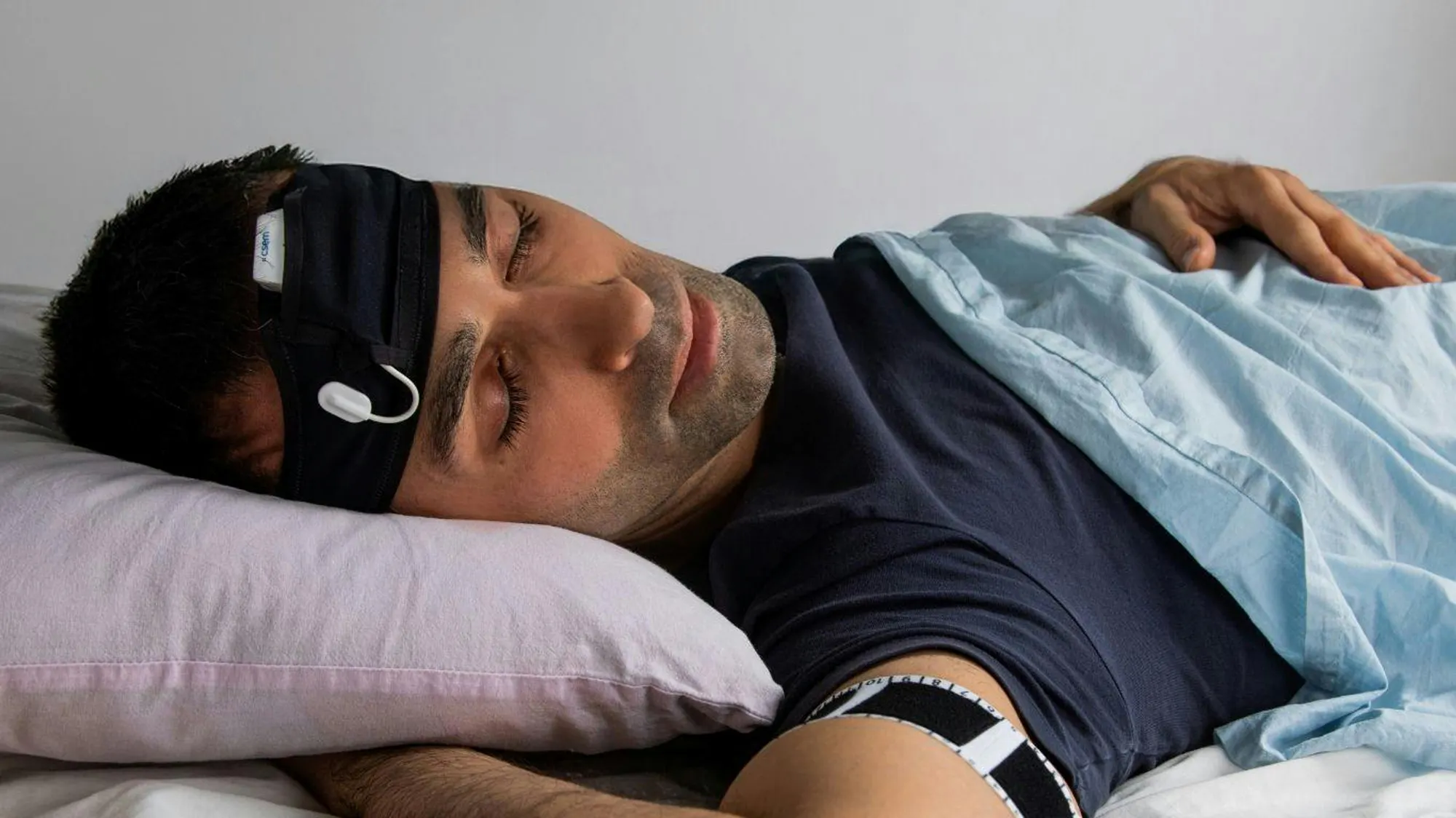
ULTEEMNite EEG headband (related video).
ULTEEMNite is a lightweight (17 grams) headband for monitoring EEG signals, motion (actigraphy) and posture during sleep. It supports EEG-based 5-class sleep staging and the assessment of sleep macrostructure and microstructure, including sleep spindles, K-complexes, and slow-wave activity. Designed for comfortable overnight wear, ULTEEMNite features active dry electrodes for EEG and an inertial measurement unit. It can also be adapted to acquire other biopotential signals, such as surface electromyography (sEMG).
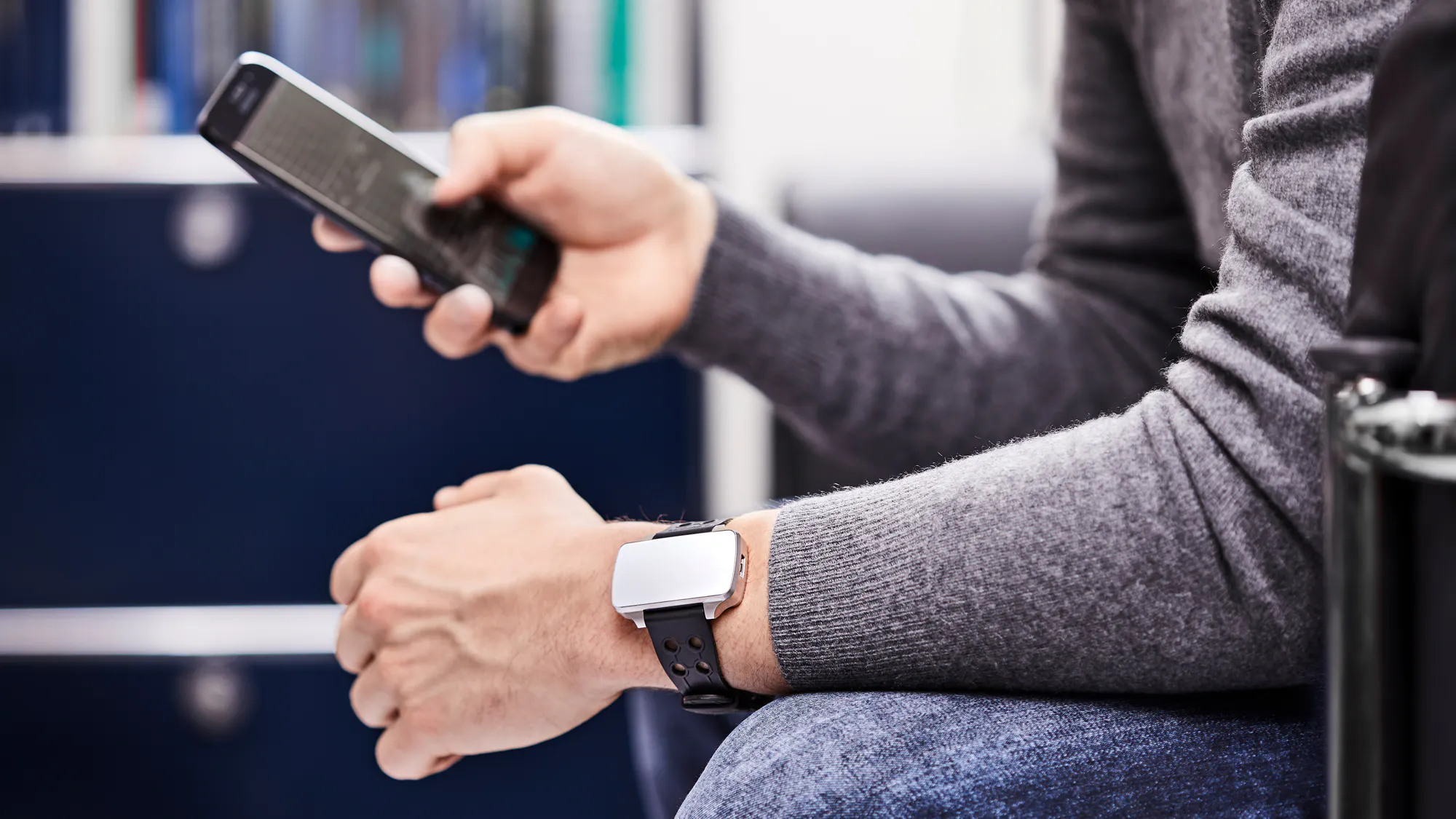
DELTA wearable device for vital-sign monitoring, shown on the wrist and adaptable to other body locations (related video).
DELTA is a wearable sensing device that combines reflective PPG, temperature sensing, and motion sensing. It can be worn on the wrist or upper arm. It supports the assessment of heart rate, heart-rate variability, SpO₂, breathing rate, blood-pressure trends, temperature, and motion. Its sensing capabilities can also support sleep-related applications, including 4-class sleep staging based on PPG-derived interbeat intervals, as well as arrhythmia screening, detection, and classification.
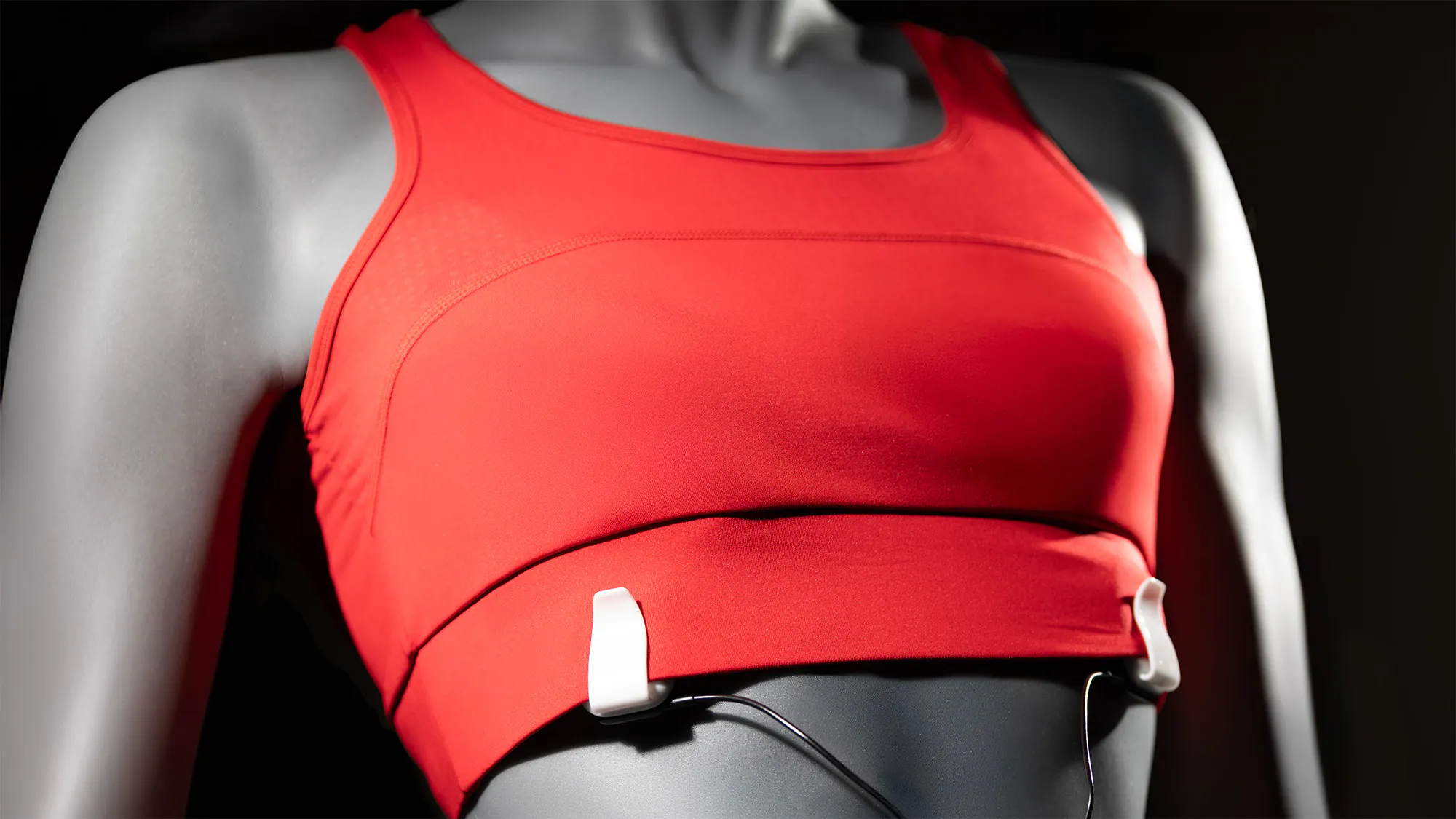
CLIP chest-worn system with clip-on fastener (related video).
CLIP is a lightweight, chest-worn dual-sensor system (22 g per sensor) for monitoring motion, sleep posture, respiratory activity, ECG, heart rate, heart-rate variability, skin temperature, and electrodermal activity. ECG-derived interbeat intervals support 4-class sleep staging, as well as arrhythmia detection and classification. It combines active dry electrodes, transthoracic multifrequency impedance measurements, temperature sensing, and inertial sensing. It can be worn with a soft, adjustable chest strap or clipped onto a bra.
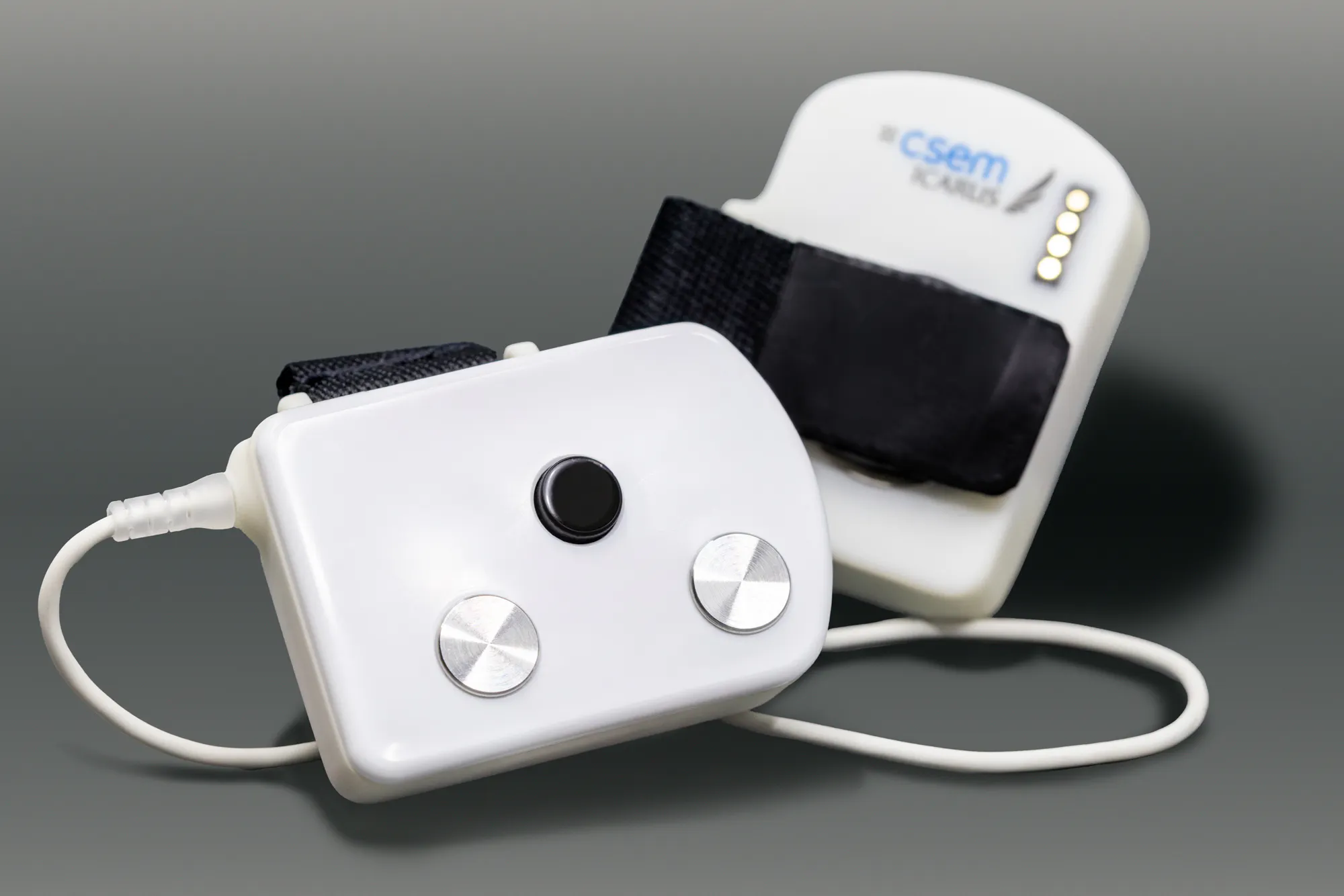
ICARUS dual-sensor system capturing chest and ambient sound.
ICARUS is a chest-worn dual-sensor system for monitoring cardiac and respiratory sounds, ambient sounds such as speech and snoring, ECG, respiratory activity, motion, and sleep posture. ECG-derived interbeat intervals support 4-class sleep staging, as well as arrhythmia detection and classification. It combines body-facing and outward-facing microphones, active dry electrodes for ECG and transthoracic impedance measurements, and a 3-axis accelerometer. It is worn using a soft, adjustable chest strap.
CSEM’s sleep-specific analytics are built on a growing evidence base combining internal wearable datasets, clinical reference datasets, real-world recordings, and access to large public sleep datasets covering thousands of nights of sleep data. This data foundation supports internal algorithm and digital-biomarker development as well as customer-specific benchmarking and product-oriented validation.
Depending on data rights, source material, and study design, CSEM evaluates wearable-derived outputs against reference methods such as polysomnography (PSG), respiratory polygraphy, or Home Sleep Apnea Testing (HSAT)-related development settings.
For example, PPG-based 4-class sleep staging on wrist-worn devices reached 78.7% accuracy (Cohen's κ = 0.68) against expert-scored polysomnography, with 94.1% sleep/wake accuracy (Constantin et al., Sleep, 2025). In 170 patients undergoing sleep-apnea screening, an oxygen desaturation index derived from upper-arm reflectance PPG predicted moderate-to-severe sleep apnea with 96% sensitivity and 70% specificity, whereas wrist-derived values were less reliable (Adam et al., 2025).
Because wearable performance depends on signal quality, device placement, population, and study context, this evidence base helps assess robustness and limitations across use cases.
Take your research results, prototype, or wearable application further with CSEM’s datasets and expertise in development, validation, and integration.
CSEM’s research roadmap focuses on technologies that make sleep wearables more unobtrusive, clinically meaningful, and suitable for long-term use outside traditional sleep laboratories.
Research activities focus on ultra-low-power wearable solutions for multi-night monitoring of sleep and respiration. Current work includes inertial-sensing-based sleep analytics, respiratory-rate assessment, body-position monitoring, sleep-apnea screening, and long-term monitoring approaches that support sleep assessment before, during, and after therapeutic interventions.
CSEM is exploring ultra-low-power edge AI to run sleep staging and sleep-apnea detection directly on wearable devices. On-device processing can reduce raw-data transmission and power consumption, strengthen data privacy, and support future real-time monitoring and closed-loop sleep-intervention concepts.
CSEM develops wearable approaches for the detection and characterization of sleep-disordered breathing. Research spans PPG-based sleep-apnea screening, multimodal respiratory assessment using motion, oxygen saturation, bioimpedance, biopotentials, and acoustic sensing, as well as investigation of respiratory-event phenotypes that extend beyond oxygen desaturation alone.
Current research advances wearable EEG technologies for unattended sleep studies and long-term monitoring. Activities include clinical validation against polysomnography, sleep staging, assessment of sleep macrostructure and microstructure, and the study of physiological processes associated with restorative sleep and brain health.
CSEM investigates digital biomarkers derived from sleep, respiratory, cardiovascular, and behavioral signals collected over extended periods. Research includes cardiovascular responses to respiratory events, blood-pressure dynamics during sleep, longitudinal monitoring of hypersomnolence-related disorders, and predictive analytics for future sleep and respiratory health applications.
Beyond passive monitoring, CSEM explores wearable systems that combine physiological sensing, real-time interpretation, and adaptive feedback. Ongoing research investigates future concepts for insomnia management, sleep-bruxism mitigation, sleep-apnea intervention, and other personalized approaches aimed at supporting sleep health while minimizing disruption of natural sleep processes.
CSEM's sensing and algorithm blocks are modular and designed to be integrated into partners' own hardware and software. Depending on the project, collaboration can range from algorithm licensing to device and system co-development, with intellectual-property terms (link to IP webpage) defined for each project.
The following publications and technical resources support CSEM’s work in wearable sleep staging, respiratory and cardiovascular assessment, sleep-apnea screening, and EEG-based sleep monitoring.